Mark Macedonia
I’ve recently returned from a two-week vacation in Italy. Yes, everything about it was fantastico! I could use a variety of superlatives ranging from wonderful, educational, beautiful, and friendly, to challenging and exhausting—all are true. But I wouldn’t be telling you something you either already know, or have already been told. Rather, allow me to offer a different point of view.
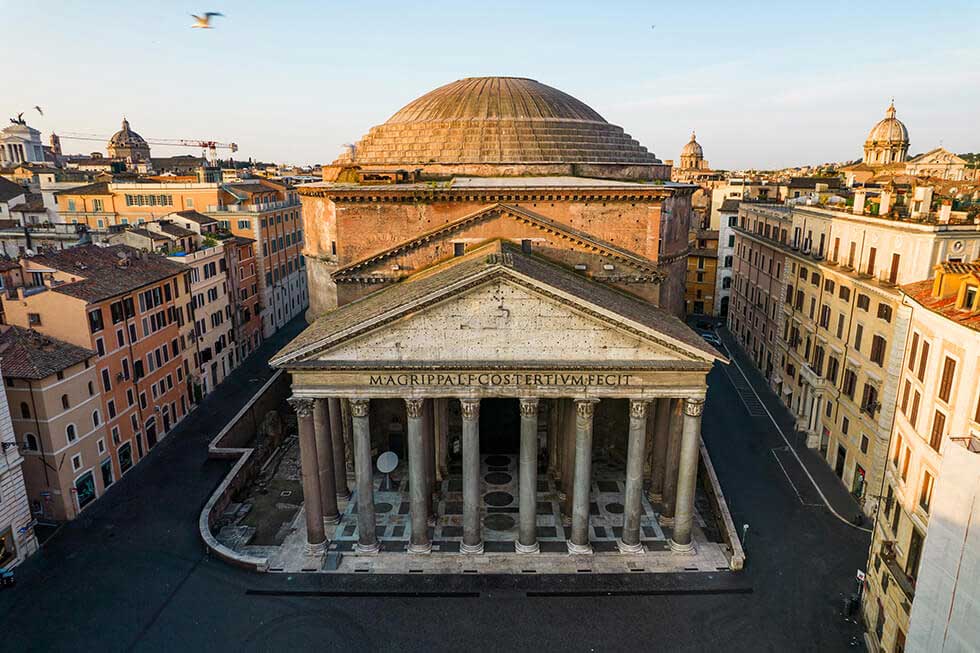
My wife and I, along with another couple—two very good friends—began our trip with three days in Florence. From there we traveled to a stunning villa overlooking the Amalfi coastline in Furore where we spent four days. Next, we journeyed to Naples to walk among the ruins of Pompeii, and finally ended our trip with four days in Rome. Our hotel in Rome was located across the piazza (public square) from Rome’s best-preserved religious building completed in 126 CE during the reign of Emperor Hadrian. It’s called the Pantheon, and is one of the greatest marvels in engineering ever achieved. The structure’s dome is 142 feet in diameter and is the largest unreinforced concrete dome in the world. The height of the dome equals its diameter, creating a perfect sphere inside the building. Outside the front of the Pantheon are positioned 8 stone columns. Each column stands 39 feet high, is 5 feet in diameter, and weighs around 65 tons. Today’s engineers remain baffled on how the entire structure was assembled using ancient tools. Certainly, with access to steel for reinforcement, and computer technology to assist with the accuracy of measurements, the Pantheon could be reconstructed today. But again, the Romans did it with only hand tools! Incredible! And as we toured the Roman forum, the Colosseum, Trajan’s market, etc., it was evident by all, that the skill, determination, and ingenuity of the ancient Romans was outstanding. It got me thinking about the other ancient marvels of engineering such as Egypt’s Great Pyramid of Khufu, the Inca stone buildings of Machu Picchu, and China’s Great Wall, just to name a few. These magnificent engineering projects created by ancient peoples represent an evolutionary process that I believe is best described as an arc of human achievement. Yet, I am reminded that such ancient peoples were consumed by constant warfare and horrendous brutality toward even their own citizens.
Twelve thousand years after the birth of civilization, and despite a continuous cycle of violence, history has recorded the attempt by humans to bring an arc of human compassion up to speed with the astonishing architectural and construction achievements of man. However, the attempt has been akin to the story of the race between the hare and the tortoise—the arc of compassion representing the latter. And although we’ve made progress in recognizing the value of human life, an examination of the events of our time period suggest we still have a long way to go; for the quest to enhance compassion among mankind remains as elusive as is the mystery in how the Romans perfected the building of the Pantheon with ancient tools.